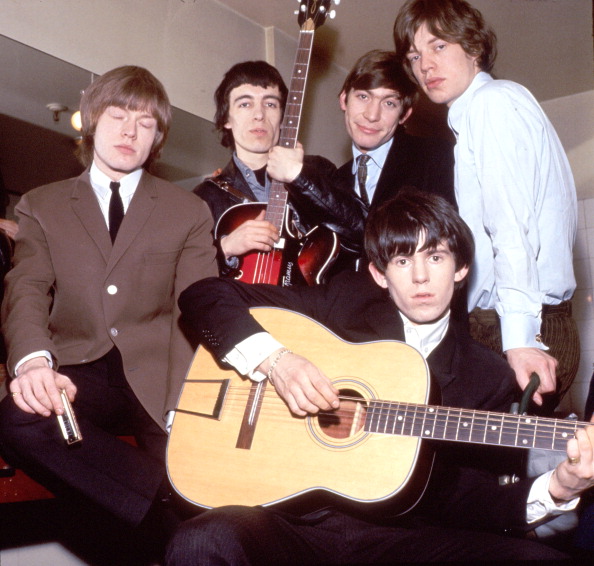
In “The Beatles vs. the Rolling Stones: Sound Opinions on the Great Rock ‘n’ Roll Rivalry” (Voyageur Press), Tribune music critic Greg Kot and Jim DeRogatis, cohosts of the nationally syndicated public-radio show “Sound Opinions,”
tackle one of the liveliest debates in rock history: Who’s cooler, the
Beatles or the Stones? The dueling critics discuss and debate the bands’
hard-scrabble beginnings in Britain during the early ‘60s, make
head-to-head comparisons of iconic albums (which is the better double
album, the Stones’ “Exile on Main Street” or the Beatles’ self-titled
“white album”?), evaluate the band members’ individual contributions
(who’s really the more accomplished drummer, Charlie Watts or Ringo
Starr?) and assess the bands’ legacies as trend-setters, image-makers
and musical visionaries. In the following excerpt about the bands’
psychedelic phase, Kot (GK) and DeRogatis (JD) dish on the Beatles’
“Sgt. Pepper’s Lonely Hearts Club Band” and the Stones’ “Their Satanic
Majesties Request.”
JD: When it comes to
the psychedelic years, I have to say that it always bugs me that the
Beatles are portrayed as the “Acid Apostles of the New Age,” leading
rock ’n’ roll into the psychedelic flowering of the mid-‘60s. The
Rolling Stones are considered to have sneered at the genre — the drugs,
the sounds, and the whole "peace and love" hippie movement — dabbling in
it reluctantly, at best, and laughing at it, at worst. Conventional
wisdom is that the Stones were mocking “Sgt. Pepper’s Lonely Hearts Club
Band” with “Their Satanic Majesties Request,” never really buying into
the idea of using psychedelic drugs as the portal to journey "toward the
white light," to use the phraseology of the time. I’m going to argue
that this view isn’t right at all, and that the Beatles and the Stones
really got to psychedelia at pretty much the same time, beginning in
1965 and coming to full fruition in 1966.
GK: Yes,
the Stones did more than just dabble in the sounds of that era, and the
key was Brian Jones. Many remember him as being the purest of the blues
purists among the Stones, at least initially, but he was also the guy
visiting Morocco to study and record the Master Musicians of Joujouka.
During the Stones’ middle period (1965-67), Jones’ influence on those
records was profound in the way he was able to bring in all these exotic
instruments and help Mick Jagger and Keith Richards turn this
blues-rock band into a Swinging London pop group — edgy and nasty, sure,
but still a force on the pop charts with distinctive-sounding singles
(“Paint It, Black,” “Ruby Tuesday,” “Lady Jane,” “Under My Thumb”). A
lot of these instruments, most of them played by Jones, influenced the
psychedelic sound that you’re talking about: dulcimer, sitar, marimba,
recorder, oboe, Mellotron.
JD: For me, the Beatles’ 1966 album “Revolver” is
the best album of this era, and for that matter the best album either of
these two bands made. But I also believe the Stones’ acid-rock
statement, “Their Satanic Majesties Request,” is a better album than the
Beatles’ “Sgt. Pepper’s Lonely Hearts Club Band,” which opened the door
to the “Summer of Love” in 1967.
GK: You’re
nuts. “Satanic Majesties” includes some god-awful music. "Sing This All
Together (See What Happens)," "Gomper," "2000 Man" —- those are pretty
flimsy tracks, and way more self-indulgent than anything on “Sgt.
Pepper’s.” The Stones were a distracted band at the time. When they were
making this record, Mick Jagger, Keith Richards, and Brian Jones all
had drug busts hanging over their heads, and they sound like they
couldn’t bother to actually finish some songs.
JD: The band’s famous line was that the album was made "under the influence of
bail."
GK: Other people in the Stones camp had to step up.
JD: Bill Wyman did more than he had ever done in the studio at that point.
GK: And Nicky Hopkins was a big part as well on keyboards.
JD:
Absolutely. But even if the lesser moments are not A-level Stones songs
— "On with the Show" could be dismissed as hokey vaudeville, "Sing This
All Together" is basically an acid campfire song, and Wyman’s
contribution of "In Another Land" is evidence of why he doesn’t have
more song credits on Stones albums — they are less offensive than "When
I’m Sixty-Four" or "Lovely Rita" and the other weaker moments on “Sgt.
Pepper’s.” Here we are at the epicenter of the youth-culture revolt, the
high moment of "tune in, turn on, drop out," and Paul McCartney is
romanticizing being an old geezer and giving us a love song to a cop!
And it doesn’t end there. In "She’s Leaving Home," he sympathizes with
Mom and Dad rather than the girl who’s setting off on her own in the
first full blush of independence. Again and again, McCartney sympathizes
with the establishment on “Sgt. Pepper’s” rather than the
counterculture. Meanwhile, John Lennon is tripping like a wildebeest,
writing one brilliant song about a circus poster ("Being for the Benefit
of Mr. Kite!") and another, "Lucy in the Sky with Diamonds," full of
hallucinatory images and bearing the convenient initials L-S-D.
Otherwise, he’s pretty much missing in action.
GK:
There is an inclusiveness to the Beatles’ psychedelia that the Stones
actively resisted. The Stones were still saying "Kiss off!" on “Their
Satanic Majesties Request.” In fact, they were booting out their manager
and producer Andrew Loog Oldham as they were making that album too,
because he didn’t understand it or want to be any part of it either. The
Beatles’ vision of psychedelia was partially tongue in cheek with "When
I’m Sixty-Four," but there was also a sense of "There’s room for
everyone."
JD: You can’t discount the British
class system. There was a side to McCartney, as there was to many of the
progressive rockers who got their start after “Sgt. Pepper’s,” that
found him very much wanting to be recognized as a capital-A "Artiste,"
because it wasn’t enough to be a grimy, working-class rock ’n’ roller.
Many of the British rockers inspired by “Sgt. Pepper’s” came from art
schools, and they wanted to make their parents proud. You get no sense
of that from the Stones. In many ways, it’s a much more American
attitude. The Beatles put on the old-time costumes of a Victorian band
that might play in the park on Sunday afternoons to make old ladies
smile. It doesn’t seem like a brave new vision of the future, whereas
the cover of “Satanic Majesties” shows the Stones dressed as warlocks,
with the threat of dark, dangerous sex magick brewing, as Aleister
Crowley might say.
GK: Shtick, I say. But there
was no lack of shtick in the “Pepper’s”-era Beatles either, as they
created an alter-ego band and played dress-up on the album cover. If you
talk about the blockbuster era when artists like Michael Jackson,
Fleetwood Mac and Bruce Springsteen were trying to make albums that fit
every radio format, in some ways, it starts with “Sgt. Pepper’s.” The
Beatles knew they were the biggest rock band in the world, and they made
this open-hearted, universal rock record. By playing to the middle,
seeking the widest audience possible, they naturally diluted some of
what made them great. “Satanic Majesties” is getting a second wind 40
years later because even though it was doing a bit of trend-riding, it
did it in a perverse way. It now looks like the more daring record.
JD: Remember
that in the chorus of "In Another Land," which Wyman originally
entitled "Acid in the Grass," Jagger sings with a sneer, "Then I
awoke/Is this some kind of joke?" They are laughing the whole way
through! No matter how hard they try, the Stones just can’t pull off the
peace-love trip with a straight face.
GK: Listen
to "2000 Man," where Jagger sings about what he’s going to be like in
the 21st Century: "Oh, daddy, your brain’s still flashin’/Like it did
when you were young." He was doing it as a snide joke then, but here he
is, the 2000 Man, still at it.
JD: Contrary to
some accounts, the Stones did not completely turn away from psychedelia
after “Satanic Majesties,” even though it was a flop and roundly panned
by the critics. Even Ian Stewart, the most faithful of Stones sidemen,
called it "that damn Satanic Majesties album." But echoes of the
psychedelic Stones continue with "Child of the Moon," which follows
“Satanic Majesties” and is a gorgeous song. There’s also the breakdown
in the middle of "Rocks Off" on “Exile on Main Street,” which is pure
psychedelia . . .
GK: And "Moonlight Mile" too —
a beautiful song that talks about, and sounds like, it was done under a
"head full of snow." They did take bits of that legacy and sprinkle it
throughout their music. A lot of people think that they took that hard
turn on “Beggars Banquet” in 1968, back toward a more linear rock style,
because of the utter failure of “Satanic Majesties,” but they retained
touches of psychedelia from then on. It’s also interesting where the
Beatles went after “Sgt. Pepper’s.” Lennon was fed up with the gimmickry
and spending nine months in the studio to make a record. You listen to a
song like "I Am the Walrus," and it certainly is psychedelia incarnate,
but he’s mocking the whole era in a way. It’s his way of saying,
"You’ve got it all wrong, kids. You’re looking for profundity and
meaning where there is none." A bit harsh, but it was his way of dealing
with the fawning adulation, and the Beatles’ every gesture being
hyper-analyzed. I’d agree with him. I look back on “Sgt. Pepper’s” and
“Satanic Majesties” as period pieces more than anything else. There is
some brilliant stuff on both records, but “Pepper’s” is generally way
overrated now and “Satanic” mostly underappreciated. The reality is,
they both fall somewhere in the middle of both of those bands’ catalogs.